

Spider-Man just broke the all-time domestic opening weekend record.
$360 million. One weekend. One character.
Spider-Man: Brand New Day beat Avengers: Endgame, a movie that featured dozens of Marvel characters, a decade of buildup, and arguably the most anticipated film in history.
And it did it with a single character that Marvel sold to Sony for roughly $7 million in 1999.
Let that sit for a second. $7 million. For the character that just generated $360 million in three days.
That transaction tells you everything you need to know about what happens when a business owner sells their most valuable asset without understanding what it is actually worth.
Marvel’s Collapse
In the early 1990s, Marvel was riding high.
The comic book speculator boom had collectors buying multiple copies of every issue, convinced they were investing in the next Action Comics #1. Marvel leaned into it.
They printed variant covers, holographic editions, and limited runs designed to create artificial scarcity.
Then they made the mistake that kills a lot of businesses: they confused a revenue spike for a new baseline.
Marvel expanded aggressively. They acquired trading card companies, sticker companies, and a distribution network. They took on massive debt to fund acquisitions that had nothing to do with their core business, which was creating characters and stories that people loved.
When the speculator bubble burst in 1993, the entire comic book market collapsed. Retailers went under. Distributors folded. And Marvel, now bloated with debt from all those acquisitions, filed for bankruptcy on December 27, 1996.
The company owed over $693 million. Over one-third of employees were laid off.
Marvel had created some of the most recognizable characters on the planet and nearly destroyed itself by chasing revenue in every direction except the one that mattered.
The Fire Sale
When you are bankrupt and desperate, you sell whatever someone will buy.
Marvel started licensing its characters to Hollywood studios for what now looks like pocket change.
Fox acquired the film rights to the X-Men for $2.6 million in 1993. The X-Men franchise has since grossed over $6 billion worldwide.
Sony locked up Spider-Man for roughly $7 million in 1999. The Spider-Man films have generated over $9 billion in global box office revenue. Brand New Day alone may clear $2 billion before it leaves theaters.
Other characters went to other studios. Blade. The Fantastic Four. Hulk distribution rights to Universal. Daredevil and Ghost Rider to Fox. Punisher to Lionsgate.
Marvel took the cash because they needed it to survive. But the terms of those deals meant that as long as the studios kept making films, they kept the rights. Marvel had sold its crown jewels on terms that gave someone else the upside forever.
This is exactly what happens when a business owner sells under pressure without understanding the long-term value of what they are giving away.
The Bet That Changed Everything
Here is where the story gets remarkable, and where the real business lesson lives.
By the mid-2000s, Marvel had reorganized out of bankruptcy. They still had their comic book publishing. They still had merchandise licensing. And they still had the film rights to a handful of characters that no studio had bothered to buy.
Iron Man. Captain America. Thor. Black Widow. Hawkeye. The characters that, at the time, most people outside of comic book readers had never heard of.
Marvel looked at what they had left and made a decision that most people thought was insane.
Instead of licensing those remaining characters to a studio for a safe upfront fee, they decided to make the movies themselves. Marvel Studios secured a $525 million credit facility from Merrill Lynch, putting up the film rights to ten of their remaining characters as collateral.
If the first movie flopped, Marvel would lose those characters too. They would have nothing left.
The first movie was Iron Man. May 2008. Robert Downey Jr. A character that general audiences did not know, played by an actor that Hollywood had written off.
It grossed $585 million worldwide.
Marvel proved that the value was never in any single character. The value was in the system. The storytelling. The universe. The ability to connect characters across films in ways no studio had ever attempted.
They took the B-list characters that nobody wanted to buy and built the most valuable entertainment franchise in history.
Disney Pays $4 Billion
One year after Iron Man, Disney acquired Marvel Entertainment for $4 billion in 2009.
Think about those numbers together.
Fox paid $2.6 million for the X-Men. Sony paid $7 million for Spider-Man. Disney paid $4 billion for everything that was left.
Why? Because Disney was not buying characters. They were buying a system, a universe that had proven it could turn any character into a billion-dollar property.
The MCU has since generated over $30 billion in worldwide box office alone. That does not include merchandise, theme parks, streaming content, or licensing.
Disney’s $4 billion investment has returned more than seven times over in box office revenue alone, and the machine is still running.
What Business Owners Can Learn from This
Marvel’s story is not just an entertainment history lesson. It is a business valuation case study.
Know what your core asset actually is. Marvel nearly destroyed itself by diversifying into trading cards, stickers, and distribution. The core asset was always the characters and the stories. Everything else was a distraction. If you own a business, the first question is: what is the thing that actually drives the value? Not the revenue. The value.
Do not sell under pressure without understanding what you are giving away. Marvel sold Spider-Man for $7 million because they were desperate. That character is now worth billions. Business owners who sell during a downturn, a health scare, or a partnership dispute almost always leave money on the table. Sometimes generational money.
The value is in the system, not the individual pieces. Disney did not pay $4 billion for Iron Man or Captain America. They paid for the interconnected universe, the production system, the storytelling engine that could take any character and turn it into a global franchise. If your business depends entirely on you, on one product, or on one client, the market will price it accordingly.
Bet on what you have, not what you lost. After losing Spider-Man, the X-Men, and the Fantastic Four, Marvel could have accepted its fate as a licensing company collecting small royalty checks. Instead, they bet $525 million on the characters nobody else wanted. Most business owners, after losing a major client or a key employee, play defense. The ones who win are the ones who look at what they still have and go all in.
Timing matters more than most people think. Marvel could not have made Iron Man in 1998. The technology was not there, the market was not ready, and the company was not stable enough to take the risk. They waited until the conditions were right, built the team, secured the financing, and executed. In business, knowing when to act is often more important than knowing what to do.
Sony paid $7 million for Spider-Man. That character just put up $360 million in a single weekend.
The question is not whether your business is valuable. The question is whether you know exactly how valuable it is, and whether you are building it or giving it away.
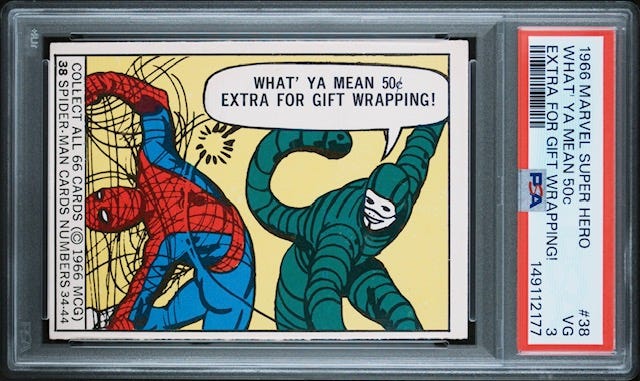
This is not Spider-Man’s rookie card, but it depicts a villain in Brand New Day.
The Spider-Man Rookie Card
This brings me to something I have been talking about in the collectibles space.
Spider-Man’s rookie card. Total PSA graded population across all grades: 350.
That is it. 350 copies graded in existence.
Meanwhile, Pokémon cards with population counts of 6,000 are trading at the same price or higher.
Spider-Man is one of the most recognizable characters in the history of pop culture. Sixty-plus years of comics, films, merchandise, and media. An IP that has generated tens of billions of dollars. And the total graded population of his rookie card is 350.
The gap between cultural significance and collectible market pricing is enormous right now.
At some point, someone who grew up watching every Marvel movie is going to ask: “Is there a Spider-Man rookie card? What does that cost?”
That moment has not happened at scale yet. But with Brand New Day breaking every record in sight, it is getting closer.
The same pattern that made Marvel’s IP undervalued in the 1990s is showing up in the collectibles market today. People are not seeing the asset clearly yet.
Remember, with great power comes great responsibility.
See you next time, cheers!
Disclosures:
This blog contains general information that may not be suitable for everyone. The information contained herein should not be construed as personalized investment advice. There is no guarantee that the views and opinions expressed in this blog will come to pass. Investing in the stock market involves gains and losses and may not be suitable for all investors. Information presented herein is subject to change without notice and should not be considered as a solicitation to buy or sell any security. Revolutionary Wealth LLC does not offer legal or tax advice. Please consult the appropriate professional regarding your individual circumstance. Past performance is no guarantee of future results.