
Collectibles have never been hotter, on a sustainable basis, than they are today. Sports cards, One Piece, Pokémon, and more are setting historic sales records.
The buzz in every hobby is the chase. The next big player. The card that triples.
Geoff Wilson and creators like him have done a masterful job educating the market on what the hobby can do for you financially.
There is one thing nobody is talking about. Taxes.
As a financial advisor who focuses heavily on tax and estate planning, I have never seen more collectors get blindsided by the same thing.
The IRS treats your collection differently than every other investment you own. Not a little differently. A lot.
I personally have multi five-figures in cards and comics. I also have a trust and a plan for my family if something happens to me. That experience is why I feel qualified to lead this conversation.
Today I am walking you through the tax implications of buying, selling, and holding collectibles. Estate planning gets its own post. Make sure you are subscribed so you do not miss it.
Pull up a chair. Let’s talk taxes and cards.
The Government Gets 28 Cents of Every Dollar You Make
Most people assume that if you hold something for over a year, the long-term capital gains rate kicks in at 0%, 15%, or 20% depending on your income. That is true for stocks and bonds. It is not true for collectibles.
The IRS defines collectibles under Section 408(m): art, antiques, stamps, coins, sports cards, trading cards, Pokémon cards, alcoholic beverages, precious metals. When you sell any of these at a profit after holding them for more than a year, the maximum federal capital gains rate is 28%.
Not 15%. Not 20%. 28%.
To put that in real numbers: you bought a 1952 Mickey Mantle card for $5,000. You held it for three years and sold it for $25,000. Your gain is $20,000. The federal government’s portion is up to $5,600.
That card you paid $500 for and sold six months later for $8,000? Held less than a year, which means it’s taxed as ordinary income. At the higher brackets, that’s 37%. You owe $2,775 before your state even shows up to the party.
A dollar lost in taxes is a dollar gone forever.
And for those of you in California or New York, your state is absolutely showing up to the party. More on that in a minute.
The Best Tax Break Nobody Talks About Is Dying With Your Collection
That’s a dark sentence. But it is true.
When you pass a collectible to your heirs, something called a step-up in basis occurs. Your heir receives the collection with a new cost basis equal to its fair market value on the date of your death. Every dollar of appreciation that happened during your lifetime is wiped off the books.
Here is what that means in practice.
You bought a 1986 Fleer basketball card set in 1990 for $10,000. In 2026, it’s worth $100,000. If you sell it today, you pay capital gains tax on $90,000 of appreciation, up to $25,200 in federal taxes alone.
If you pass it to your kids, they inherit it at a $100,000 basis. They turn around and sell it for $100,000. They owe nothing.
Only appreciation after the date they inherited it becomes taxable. The $90,000 you built over 36 years? Completely untaxed.
For collections that have appreciated significantly over decades, this is one of the most powerful estate planning tools available. It requires a professional appraisal to establish the value at the time of death, proper documentation, and a will or trust that is set up correctly. But the math is compelling.
One caveat: Congress has been eyeing this provision for years. It is not guaranteed to exist in its current form indefinitely. If your estate plan depends on this, make sure you are working with an advisor who stays current on tax legislation.
Here is the part most people are not thinking about, and it matters right now.
The step-up in basis only resets the clock. It does not remove the tax obligation going forward. Whatever the collection is worth on the day they inherit it becomes their new starting line. Any appreciation after that point is fully taxable when they sell.
The Ohtani market is up roughly 300% since last spring. Someone who inherited a $10,000 Ohtani collection a year ago and is sitting on $40,000 today has a $30,000 taxable gain waiting for them the moment they sell. They did not plan for that. Most of them do not even know it exists.
And Ohtani is not a unique situation. Markets move. Players break out. A collection that was worth $15,000 at inheritance can be worth $60,000 eighteen months later, and the heir is holding a tax liability they never anticipated.
There is a planning strategy specifically designed for this scenario, and it changes the outcome significantly. I am going to cover it in full in the next post on collectibles and estate planning. If your collection has appreciated meaningfully since you inherited it, that is the one you do not want to miss.
The 1031 Exchange Myth That Won’t Die
I hear this one constantly. “Can’t I just trade my Mantle for coins and defer the taxes?”
No. You cannot.
A lot of collectors still believe Section 1031 like-kind exchanges apply to cards, coins, art, and other collectibles. They did, until the Tax Cuts and Jobs Act of 2017 closed that door permanently.
As of January 1, 2018, Section 1031 applies to real property only. Stocks, bonds, collectibles, and personal property of any kind no longer qualify.
If you sell a $50,000 card and immediately reinvest every dollar into another card, you still owe tax on the gain from the sale. The reinvestment does not defer anything.
This myth persists because older content online still describes the pre-2018 rules. I have had clients come in convinced they had a strategy, and it was painful to explain that the strategy had not been legal for years.
There is no like-kind exchange for your collection. Plan accordingly.
Buying and Selling Cards Is a Hobby Until It Isn’t
Here is where a lot of active card flippers get themselves into trouble.
If you are regularly buying and selling collectibles with the intent to make a profit, the IRS may decide you are not a collector at all. You are a dealer. And dealers don’t get the 28% capital gains rate.
Dealers pay ordinary income tax on their profits. They also pay self-employment tax, which adds 15.3% on top of that. On the other hand, they can deduct legitimate business expenses: storage, shipping, grading fees, travel to card shows, subscription tools like Market Movers.
The legal distinction lives in two places. Under IRC Section 1221(a)(1), property held primarily for sale to customers in the ordinary course of business is excluded from capital asset treatment — meaning your gains are ordinary income, not capital gains.
The self-employment tax on top of that falls under IRC Section 1401. Together, those two code sections are what turn a profitable hobby into a significantly more expensive tax situation.
The IRS looks at several factors to determine your status. How frequently are you buying and selling? How much time are you spending on it? Are you relying on it for income? Do you have specialized knowledge and expertise in the market?
I will tell you from personal experience that I have been on the wrong side of some of those questions at various points in my card collecting journey. Grace would tell you that the frequency of my transactions has at times been alarming.
If you are flipping consistently and profitably, talk to a tax professional before tax season.
The distinction between investor and dealer has significant financial consequences, and it is not always obvious which side of the line you are standing on.
eBay Is Now Telling the IRS About You
This one catches people off guard every year.
Any platform where you sell, including eBay, COMC, and similar marketplaces, is now required to issue a Form 1099-K if you receive more than $600 in a calendar year. That threshold used to be $20,000. It is now $600.
If you sold anything meaningful this year on a resale platform, the IRS already has a record of it. Your job is to make sure your records match theirs.
That means keeping documentation of every purchase: the date you bought it, what you paid, any grading or authentication fees, and any shipping or transaction costs. Those costs are added to your basis and reduce your taxable gain.
A card you bought for $100, sent to PSA for $20 in grading fees, and sold for $300 has a taxable gain of $180, not $200. Small differences add up quickly when you are running volume.
If you are profitable and selling consistently, you may also owe quarterly estimated taxes. The IRS expects you to pay as you go, not just at April 15. Missing those quarterly payments comes with penalties.
What This Means for You
If you have a collection that has appreciated significantly, the tax implications are real and they compound quickly. The 28% federal rate is higher than most people realize.
The step-up in basis at death is more powerful than most people use. The dealer vs. investor distinction matters more than most active flippers know. And the record-keeping requirements are non-negotiable if you ever want to defend your numbers.
None of this is reason to stop collecting. It is reason to collect with a strategy.
I have spent years buying cards with no strategy and years buying them with one. The difference in outcomes is not subtle.
Next week I will be walking through how to evaluate whether your collection is an asset or a liability in your overall financial plan. Different question than most collectors are asking themselves. Important answer.
If you have a collection worth more than $25,000, sit down with a financial advisor or tax professional who understands collectibles specifically before your next significant purchase or sale. The cost of the conversation is almost always less than the cost of not having it.
I work with collectors, just like myself, on this every day.
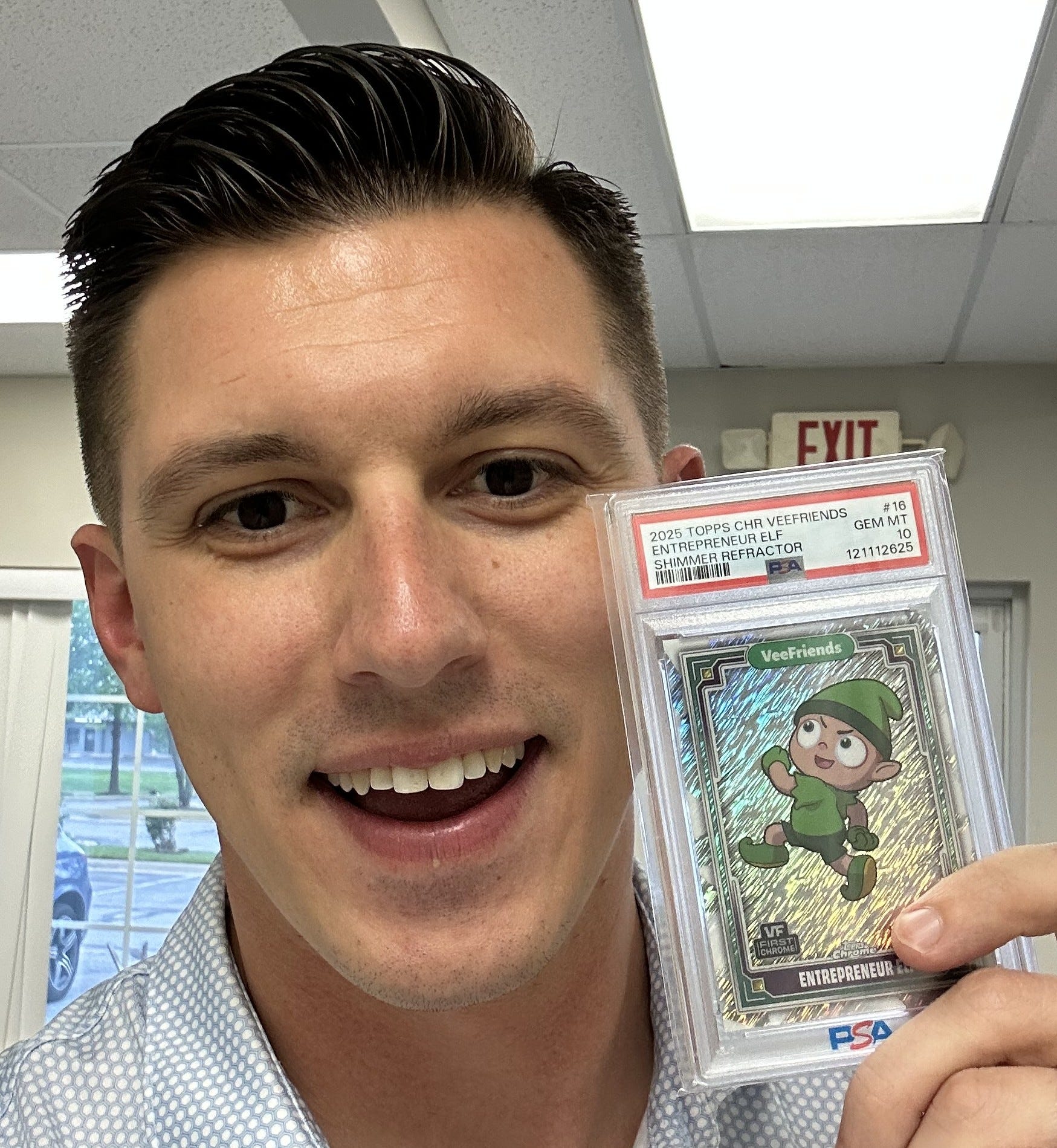
The Veefriends character that identifies me with the most, the Entrepreneur Elf.
Want the Same Rush of Opening a Pack in Your Cup?
Most people order a dark roast when they want the caffeine. Darker bean, stronger hit. That is the assumption.
It is backwards.
The roasting process burns off caffeine. A light roast has measurably more caffeine than a dark roast. The bold taste is not the true hit.
Coffee futures hit $3.48 per pound in late 2024, an all-time record. A specialty bag that cost $14 in 2021 runs $28 today. That is a 100% increase in three years.
Your card collection is not the only thing the market has repriced.
Don’t be cheap, buy the good stuff and shop local.
Cheers!
Disclosures:
This blog contains general information that may not be suitable for everyone. The information contained herein should not be construed as personalized investment advice. There is no guarantee that the views and opinions expressed in this blog will come to pass. Investing in the stock market involves gains and losses and may not be suitable for all investors. Information presented herein is subject to change without notice and should not be considered as a solicitation to buy or sell any security. Revolutionary Wealth LLC does not offer legal or tax advice. Please consult the appropriate professional regarding your individual circumstance. Past performance is no guarantee of future results.