

Every serious collector knows their anchor card. The one that defines the collection.
The highest grade. The lowest pop count. The piece you would never sell at any price.
A trust is the anchor card of your estate plan.
And just like the rarest card in a collection can be sitting in a binder with no sleeve, no top loader, and no documentation of what it is actually worth, a trust can exist without doing the one thing it needs to do.
Having a trust does not mean your collection is protected. Having the right trust does.
Here are three situations that show the difference.
Case Study #1: The Wrong Appraiser
A collector passed with a collection his family knew was significant. They had a trust.
It named his wife as trustee and his two adult children as beneficiaries. The language said the collection should be appraised and proceeds distributed equally.
So far, so good.
The trustee hired a general estate appraiser. Not a collectibles appraiser. Not someone who understood grading standards or pop reports.
Someone who did what general appraisers do: pulled comparable eBay sold listings and averaged them.
The appraisal came in more than $140,000 below the actual market value of the collection. The estate filed that number with the IRS.
Two years later, the IRS audited. The correct value was established through a qualified collectibles appraisal. The estate owed taxes and penalties on the difference.
The trust was well-written for every other asset in the estate. It had nothing specific to say about how the card collection should be valued.
What the trust needed was one clause. Something that said graded cards require a PSA, Beckett, or SGC standard and a qualified collectibles appraiser, not a general estate appraiser working from public sold listings.
One provision. It would have changed the outcome entirely.
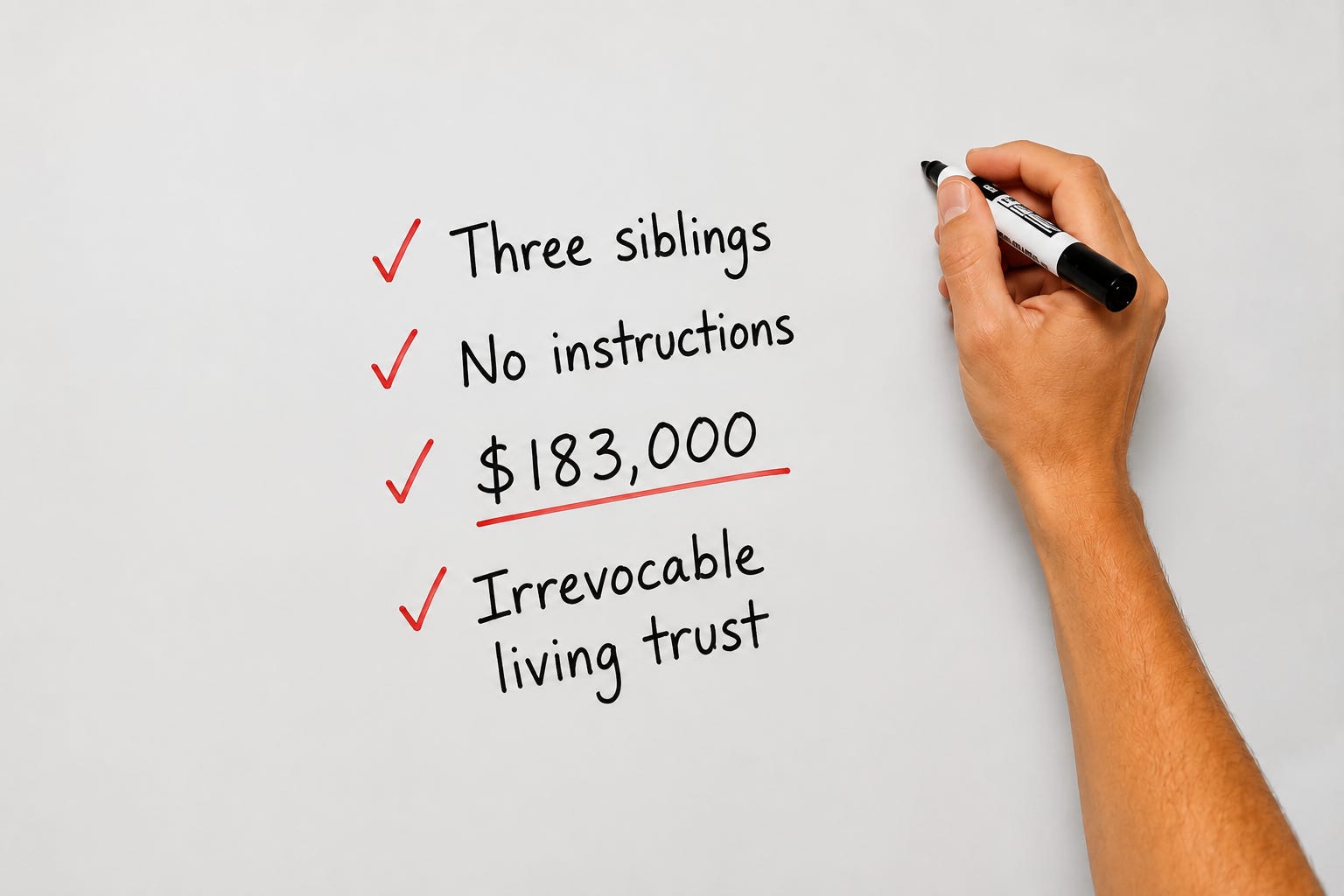
Case Study #2: Three Siblings, No Instructions
A collector passed with a collection appraised at $183,000. He had a revocable living trust. It named his three adult children as equal beneficiaries and gave the trustee authority to sell assets and distribute proceeds.
That was all it said about the collection.
One sibling had grown up collecting alongside his father. He wanted to hold the most significant pieces and let the market develop.
One sibling needed cash. She was willing to sell everything at whatever the market gave today.
One sibling had no interest in cards but wanted her equal share in dollars, not in cardboard.
Three legitimate positions. No document to settle them.
They hired a mediator. The process took 22 months. Legal and mediation fees came out of the estate. By the time they reached an agreement to sell, they were under enough financial and emotional pressure that they accepted the first reasonable offer from a local dealer.
The collection sold for 62 cents on the dollar compared to the independent appraisal done partway through the dispute.
That, ladies and gentlemen, is what happens when a trust names the heir and stops there.
What the trust needed: specific distribution language.
Which pieces went to which person, by name and by card. Which pieces got sold and through which channel.
A floor price before anything sold below a number the collector would have accepted himself.
A hold period before any significant piece moved, to prevent a panic sale at a bad price.
None of that requires a complicated trust. It requires an attorney who knows to ask the right questions about the collection before drafting.
Case Study #3: The Accounts Nobody Could Access
A collector passed with roughly $31,000 in graded inventory across two platforms: a PSA vault account and a Fanatics collect account.
His family knew he collected. They knew there were cards in the house. They did not know about the digital accounts.
They found out about the PSA vault three months after he passed when a transaction notification arrived at his email address. The Fanatics account turned up six months after that through a similar accident.
Both platforms required legal documentation and account credentials to release assets to the estate. The family had neither. They had to work through the estate attorney, file documentation with both platforms, and wait.
Total elapsed time from death to access: 14 months.
During that time, the inventory sat. Some pieces moved in value. Several pending transactions on Fanatics had to be unwound, at a cost to the estate. The family had no visibility into what was happening inside accounts they could not open.
The trust had no digital asset provision. It did not inventory the platforms. It did not designate who had authority to access them or what documentation they would need.
What the trust needed: a digital asset clause naming every platform the collection touched, authorization for a specific person to access those accounts, and a separate inventory document stored alongside the trust with login information the trustee could actually use.
That document does not need to be complicated. It needs to exist. And the person who needs to find it needs to know where it is before they need it.
What a Collector’s Trust Actually Needs to Include
Each of the situations above was preventable. Here is what collector-specific trust language covers.
The Appraisal Standard. Graded cards require a PSA, Beckett, or SGC standard and a qualified collectibles appraiser. Not a general estate appraiser using eBay averages. This clause protects the valuation at the step-up in basis and reduces IRS exposure for the estate.
Distribution Specificity. Which pieces go to which person, by name and by card. Which pieces get sold. What auction house or dealer handles significant pieces above a stated value (Probstein, Goldin, or similar). A floor price below which no piece sells without trustee approval and a second opinion from someone with market knowledge.
The Trustee Advisor. A designated person with hobby knowledge who advises the trustee on collection decisions without holding fiduciary authority. Your trustee does not need to understand the hobby. But they should have access to someone who does before making sale or distribution decisions at scale.
The Digital Access Provision. An inventory of every platform your collection touches, authorization language for a specific person to access those accounts, and documentation your trustee can actually use to gain legal access. This should be reviewed every time you open or close a platform account.
The Hold Period. A waiting window before any significant piece sells, to let the market stabilize. This is the provision that keeps a trustee from accepting the first offer out of uncertainty or time pressure.
Most collectors, whether in Bentonville or anywhere else in the country, have a trust that covers the first four: a trustee, beneficiaries, an executor for probate assets, and a pour-over will to catch anything left outside the trust.
The five provisions above are almost never in a standard trust unless someone specifically asked for them.
Most people do not know to ask.
Why Collectors End Up with the Wrong Trust
Being transparent about my own experience: I paid $4,500 for our trust before I got back into collecting seriously.
At the time, neither the attorney nor our CPA had strong answers when I came back with specific questions about the collection, the digital accounts, and the appraisal standard.
I had to do most of the research myself. And I work in financial planning.
If I personally could not get the right answers without significant due diligence, what are the odds the average collector can?
That experience is what drove us to build Blueprint Business and Tax Advisors alongside Revolutionary Wealth.
An attorney who understands how collectibles work inside an estate plan. A CPA who prepares taxes for collectors and card shop owners.
A trust drafting process that covers the five provisions above, not just the standard language.
The cost of our trust setup, at the time I am writing this, is a fraction of what most collectors have tied up in their top ten cards. That math is worth doing.
What to Do Right Now
Pull out your trust documents. Find the section that covers personal property. Read what it actually says about the collection.
If it says nothing more than the collection transfers to your beneficiaries, you have a generic trust. That is a starting point, not a finish line.
Then schedule a discovery call with us. We will walk through your current documents, your digital platforms, your distribution intentions, and your collection inventory.
We will show you exactly what the gaps are and what it takes to close them.
Every great collection has an anchor card. The piece that makes everything else worth protecting.
Make sure your estate plan has one too.
Pull up a chair. Let’s look at the numbers.
Cheers!
Disclosures:
This blog contains general information that may not be suitable for everyone. The information contained herein should not be construed as personalized investment advice. There is no guarantee that the views and opinions expressed in this blog will come to pass. Investing in the stock market involves gains and losses and may not be suitable for all investors. Information presented herein is subject to change without notice and should not be considered as a solicitation to buy or sell any security. Revolutionary Wealth LLC does not offer legal or tax advice. Please consult the appropriate professional regarding your individual circumstance. Past performance is no guarantee of future results.
Asset protection plans should be developed and implemented well before problems arise. Due to the fraudulent transfer laws, asset transfers that occur close in proximity to the filing of a lawsuit or bankruptcy can be interpreted by the court as a fraudulent transfer. Proper structuring of these assets is imperative please seek proper legal and tax advice prior to engaging in re-titling/structuring of any assets. Please note that laws are subject to change and can have an impact on your asset protection strategy.