

A referral called our office last spring. A couple, both 64, both freshly retired from the same company after 30 years each.
They had done everything the books told them to do. They maxed their 401(k)s every year. They never touched the accounts early.
They ended up with $1.9 million sitting in pre-tax retirement accounts and a paid-off house. On paper, they had won.
Then the husband said something that stuck with me. He told me their advisor said they were “all set” and to just relax until Social Security and required distributions kicked in.
So that was the plan. Coast for a few years. Sit still. Enjoy the quiet.
I asked them one question. What is your taxable income going to be this year, now that the paychecks stopped and Social Security hasn’t started?
He looked at his wife. Neither of them knew. The answer, once we ran it, was about $38,000.
Two people with nearly two million dollars in retirement accounts were about to spend the next several years in one of the lowest tax brackets of their entire adult lives.
And they were planning to do nothing with it.
That gap has a name in our office. We call them the trough years, the low-income stretch between your last paycheck and the day the government forces money back into your income. Most people spend those years relaxing.
The ones who understand what is happening use them to move a fortune out of the government’s reach through a Roth conversion, legally, permanently, and on sale.
The Window Nobody Tells You About
Here is the setup almost every retiree walks into.
You retire somewhere between 62 and 66. Your income falls off a cliff because the W-2 stopped. But you delay Social Security to let it grow, ideally to 70.
And required minimum distributions, the forced withdrawals from your pre-tax accounts, do not start until age 73 or 75 under current law.
So, you get a stretch. Call it ages 62 to 72, where your reported income is low, sometimes shockingly low, before the two biggest income sources of your retirement come roaring back online at nearly the same time.
That stretch is the single most valuable tax planning window of your life. It is also the most wasted.
Because it feels like a break. You just spent 40 years grinding. Nobody wants to think about taxes during the one calm stretch they finally earned. So, they coast.
And while they coast, the tax meter on their pre-tax accounts keeps running in the background, growing a bill that comes due later at a much worse rate.
A dollar you convert cheaply today is a dollar the government can never tax again.
A dollar you leave sitting is a dollar they get to tax at whatever rate they decide, whenever they decide, for the rest of your life and into your spouse’s.
What Actually Happens If You Wait
Let me show you the couple’s number the other way.
That $1.9 million, left alone, grows. Say it reaches $2.6 million by the time RMDs start at 75. The IRS forces them to pull roughly 3.8% out that first year.
That is about $99,000, on top of two Social Security checks now running at full size. Their income doesn’t drift up. It leaps.
They go from a couple living on $38,000 to a couple reporting well over $150,000, and every dollar of that gets taxed at the rate that stacks on top. '
The forced withdrawals grow every single year after that. Revolutionary Wealth has a blunt name for it. The tax bomb. This is the part the “you’re all set” advice never mentions.
Then there is the part nobody wants to say out loud. 63% of women outlive their husbands. When one spouse dies, the survivor files as single the very next year. The standard deduction is cut roughly in half and the tax brackets compress hard, so the same income gets taxed far more.
I have watched widows get pushed into a higher bracket the year after losing their husband, while grieving, simply because nobody moved money when the moving was cheap.
The government has quietly made itself your largest business partner. You just never signed the paperwork.
The Roth conversion window is your one clean chance to buy that partner out at a discount.
How the Conversion Actually Works
A Roth conversion is simple in mechanics and powerful in effect. You move money from a tax-deferred account, a traditional IRA, an old 401(k), a SEP, or a SIMPLE, into a Roth IRA.
The amount you move is added to your taxable income and taxed as ordinary income that year. From that point forward, the money grows tax-free, qualified withdrawals come out tax-free, and it is never subject to required minimum distributions.
Not for you. Not for your spouse. Not for the kids who inherit it.
A few facts that surprise people. There is no income limit on a conversion. The phase-outs that block high earners from contributing to a Roth do not apply here.
There is also no dollar cap. You can convert $10,000 or $10 million. And the conversion itself carries no early withdrawal penalty after age 59 1/2.
The whole game is the rate you pay on the way in.
During your working years, converting is usually a bad deal. You are already in a high bracket, so you would be volunteering to pay tax at your worst rate.
That is why you don’t hear about this at 45. Maybe a friend swore it saved him a fortune at a dinner party here in Bentonville, and maybe for him it did. Context is everything.
But in the trough years, the math flips completely. You have room underneath the top of a low bracket, sometimes a lot of room, and you can fill it with converted dollars taxed at 10%, 12%, or into the low 20s, instead of the 30%-plus those same dollars would trigger later once RMDs and Social Security stack on top.
You are not avoiding the tax. You are choosing to pay it in the cheapest years you will ever have. That is the whole thing.
Filling the Bracket, Not Blowing Past It
The mistake people make when they finally hear about this is going too big. They convert the whole account in one year, spike their income into the 32% or 35% bracket, and hand most of the benefit right back.
Converting a $1 million IRA in a single year can generate roughly $380,000 in tax at the top rates. That is not strategy. That is a bonfire.
The real approach is partial conversions, filling one bracket at a time.
Take our couple at $38,000 of income. The top of the 12% bracket for a married couple sits just under $97,000 of taxable income in 2026.
That leaves them close to $50,000 of room they could fill with converted dollars taxed at only 12%. Do that every year from 64 to 72, and they move somewhere near $450,000 out of the pre-tax account at a bracket they may never see again, all before RMDs ever begin.
That is not a small tweak. That is close to a quarter of their entire pre-tax balance relocated to a tax-free account, on sale, in years they were planning to spend doing nothing.
The 2026 federal brackets, 10, 12, 22, 24, 32, 35, and 37 percent, were preserved by recent law. That is exactly why so many pre-retirees are choosing to lock in today’s known rates while they can.
Nobody can promise you what the brackets look like in ten years. You can act on the ones in front of you now.
You are the CEO of your wealth. This is one of the few decisions where you, and not the market, control the outcome.
The market decides your return. You decide your tax rate.
Pull the right lever at the right time and it changes the arithmetic of your entire retirement.
The Bonus Window: A Down Market
There is a second window that opens without warning, and it is the one seasoned planners get quietly excited about. A market drop.
When the market falls and your traditional IRA balance shrinks on paper, the tax cost of converting shrinks right along with it. You pay tax on the smaller, beaten-down number, and the recovery happens inside the Roth where it grows back tax-free.
You are buying the same shares out of the government’s reach at a discount, at the exact moment everyone else is panicking.
Most people freeze when the market drops. A planner sees a coupon. That is the difference.
Two Things to Know Before You Hit Convert
First, it is permanent. Under current law there are no take-backs. The old recharacterization move, where you could undo a conversion, is gone.
Once the year closes, the taxable income is locked in. That is why you run the numbers before you convert, not after.
Second, the five-year rule. Each conversion starts its own five-year clock. Wait the five years, and the earnings come out tax-free and penalty-free.
It rarely trips up someone converting in their early 60s for money they won’t touch for decades, but you should know the clock exists before you start it.
If you are nervous, you need to work with seasoned professionals like our team at Revolutionary Wealth who do Roth conversions as our specialty.
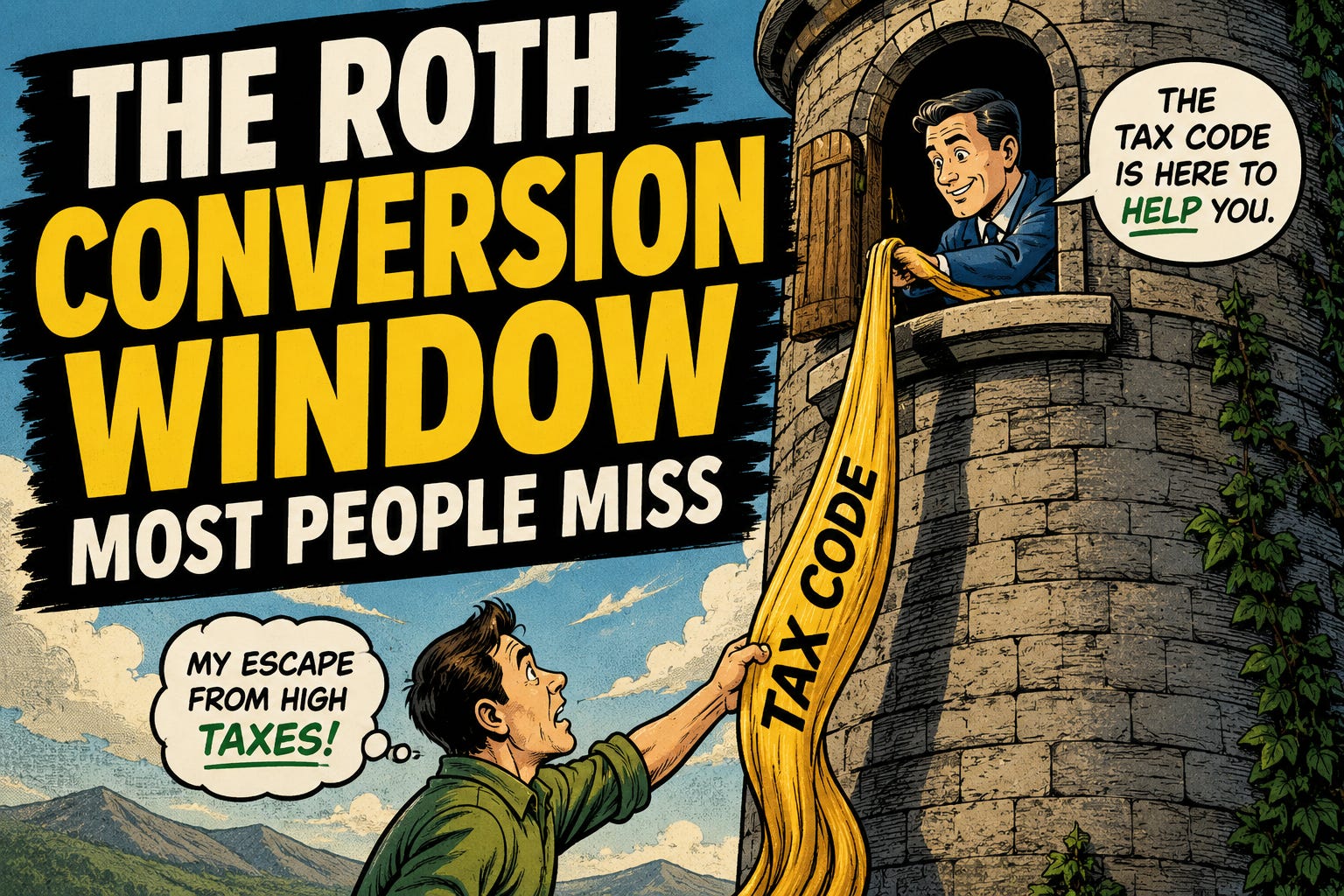
Your Window Has an Expiration Date
The hardest part of this to accept is that the window closes on its own schedule, not yours.
Every year you spend in the trough doing nothing is a year of cheap conversion space gone forever. You cannot get it back.
When Social Security turns on and RMDs begin, the low brackets fill up with income you no longer control, and the discount disappears.
I told that couple the truth. The “you’re all set” advice was not wrong about their savings. They did save beautifully.
It was wrong about their taxes, because it treated the calmest years of their financial life as a time to rest instead of the most important years to act.
The real goal is not the lowest tax bill this year. It is the lowest effective tax rate across your whole life and your heirs’ lives combined.
They are converting now. One bracket at a time.
If you are anywhere in that stretch between your last paycheck and your first RMD, here is what to do in the next ten minutes.
Pull up last year’s tax return and find your taxable income on the line before deductions. Then look up the top of your current tax bracket. The gap between those two numbers is your window, in dollars, for this year.
That number is what the government is offering you, right now, at a discount.
See you next time!
Disclosures:
This blog contains general information that may not be suitable for everyone. The information contained herein should not be construed as personalized investment advice. There is no guarantee that the views and opinions expressed in this blog will come to pass. Investing in the stock market involves gains and losses and may not be suitable for all investors. Information presented herein is subject to change without notice and should not be considered as a solicitation to buy or sell any security. Revolutionary Wealth LLC does not offer legal or tax advice. Please consult the appropriate professional regarding your individual circumstance. Past performance is no guarantee of future results.
Not associated with or endorsed by the Social Security Administration, Medicare or any other government agency.
Maximizing your Social Security Benefits assumes foreknowledge of your date of death. If as an example you wait to claim a higher monthly benefit amount but predecease your average life expectancy, it would have been better to claim your benefits at an earlier age with reduced benefits.
Converting an employer plan account or Traditional IRA to a Roth IRA is a taxable event. Increased taxable income from the Roth IRA conversion may have several consequences including but not limited to, a need for additional tax withholding or estimated tax payments, the loss of certain tax deductions and credits, and higher taxes on Social Security benefits and higher Medicare premiums. Be sure to consult with a qualified tax advisor before making any decisions regarding your IRA.
Mutual Funds and Exchange Traded Funds (ETF’s) are sold by prospectus. Please consider the investment objectives, risks, charges, and expenses carefully before investing. The prospectus, which contains this and other information about the investment company, can be obtained from the Fund Company or your financial professional. Be sure to read the prospectus carefully before deciding whether to invest. An investment in the Fund involves risk, including possible loss of principal.
Indexed annuities are insurance contracts that, depending on the contract, may offer a guaranteed annual interest rate and some participation growth, if any, of a stock market index. Such contracts have substantial variation in terms, costs of guarantees and features and may cap participation or returns in significant ways. Any guarantees offered are backed by the financial strength of the insurance company. Surrender charges apply if not held to the end of the term. Withdrawals are taxed as ordinary income and, if taken prior to 59 ½, a 10% federal tax penalty. Investors are cautioned to carefully review an indexed annuity for its features, costs, risks, and how the variables are calculated. c) If this includes fixed and indexed annuities, you can add this combined version: Fixed Annuities are long term insurance contracts and there is a surrender charge imposed generally during the first 5 to 7 years that you own the annuity contract. Indexed annuities are insurance contracts that, depending on the contract, may offer a guaranteed annual interest rate and some participation growth, if any, of a stock market index. Such contracts have substantial variation in terms, costs of guarantees and features and may cap participation or returns in significant ways. Investors are cautioned to carefully review an indexed annuity for its features, costs, risks, and how the variables are calculated. Any guarantees offered are backed by the financial strength of the insurance company. Surrender charges apply if not held to the end of the term. Withdrawals are taxed as ordinary income and, if taken prior to 59 ½, a 10% federal tax penalty.
The projections or other information generated by Monte Carlo analysis tools regarding the likelihood of various investment outcomes are hypothetical in nature, are based on assumptions that you provide which could prove to be inaccurate over time, do not reflect actual investment results, and are not guarantees of future results, but they can be complemented with additional calculators and tax planning tools. Results may vary with each use and over time.
Securities and investment advisory services offered through Integrity Alliance, LLC, Member SIPC. Integrity Wealth is a marketing name for Integrity Alliance, LLC. Revolutionary Wealth LLC, is not affiliated with Integrity Wealth.
Tax and Legal services provided are separate from the Securities or Advisory services offered through Revolutionary Wealth LLC.