

The IRS is your silent business partner.
It owns a piece of every dollar sitting in your 401(k) and your traditional IRA, and here’s the part nobody tells you at the plan enrollment meeting.
It gets to decide when it collects, not you.
Most people don’t figure that out until they’re 73 years old and the government forces their hand.
Grab your mug, pull up a chair.
This one is going to save some of you six figures, if you catch the window before it closes.
The Tax Bill You Haven’t Paid Yet
Every dollar you put into a traditional 401(k) or IRA got a tax deduction on the way in. That felt great at the time. What it actually did was create a liability, not a windfall.
You didn’t avoid the tax. You postponed it, and you let the government decide the rate later.
Here’s the part that surprises people. That balance doesn’t just sit there waiting patiently. It grows, and the tax bill grows right alongside it.
By the time you’re in your 70s, you’re often sitting on more pretax money than you ever put in, which means a bigger bill than you ever agreed to.
A dollar lost in taxes is a dollar gone forever. And the government has never once apologized for taking more than its share.
The Wrong Fix: Wait and See
Most pre-retirees do nothing about this. Not because they’re lazy, because nobody ever told them there was a window to act.
The default plan is simple. Work, save, retire, and let the required minimum distributions sort it out when the IRS says it’s time.
Here’s why that backfires. At 73, the government requires you to start pulling money out of those accounts whether you need the income or not.
Not a suggestion. A mandate, calculated by a formula, and taxed as ordinary income the year it comes out.
That forced withdrawal does three things at once, and none of them are good.
It stacks on top of Social Security, pushing more of your benefit into taxable territory.
It can trigger IRMAA, the surcharge that quietly raises your Medicare premiums the moment your income crosses a threshold you didn’t know existed.
Often it pushes retirees into a higher bracket than the one they were actually planning around, at the exact moment they have the least ability to do anything about it.
Waiting isn’t neutral.
Waiting is a decision; you just don’t get to see the bill until it’s too late to negotiate.
The Right Tool: Your Gap Years
Here’s the window almost nobody uses.
The years between when you stop earning a paycheck and when RMDs kick in at 73 or 75, and often before you claim Social Security, your taxable income drops. Sometimes it drops a lot.
That’s not a problem. That’s an opportunity with an expiration date.
During those gap years, you can convert traditional IRA dollars into a Roth IRA on purpose, paying tax now while your bracket is low, instead of later when RMDs and Social Security stack up and force you into a higher one.
You’re not avoiding the tax. You’re choosing the rate.
That, ladies and gentlemen, is the entire strategy. Fill up the lower brackets on your own terms, every year, during the window when your income has the most room in it.
Time for a refill. If you’ve never heard your CPA or advisor mention this window by name, that’s worth asking about directly.
Subscribe now if you want to catch every strategy like this one before the window closes on you.
What Six Figures Actually Looks Like
Let’s run the math on a simple example. Say you’re sitting on $800,000 in a traditional IRA at 63, freshly retired, no W-2 income yet.
Left alone, that balance keeps growing, and by 75 you could be facing RMDs in the six figures annually, taxed at 24% to 32%, on top of IRMAA surcharges and a bigger chunk of Social Security getting taxed.
Now instead, during those gap years, you convert roughly $60,000 to $80,000 a year into a Roth, deliberately filling up the 12% and 22% brackets instead of letting the IRS fill up your 24% and 32% brackets for you later.
Run that for five to twelve years and you’ve moved a meaningful chunk of that balance into tax-free territory, paid at a rate less than half of what you’d have paid on autopilot.
Over a 20-to-30-year retirement, that rate difference alone is where the six figures live.
Not from a clever investment. From choosing when you pay a bill you already owed.
One Move, Three Problems Solved
I say this often because it’s true every time I see it play out. The best planning tools solve two, three, sometimes four problems at once.
The gap year conversion is one of those.
It lowers your future RMDs, because you’ve already moved money out of the account the IRS forces you to draw from. It reduces how much of your Social Security benefit gets taxed, because your other taxable income is lower in retirement.
It keeps you further from the IRMAA cliffs that quietly raise your Medicare premiums.
And it leaves your heirs a Roth account instead of a traditional IRA, which means the money they inherit comes to them tax-free instead of as a bill with their name on it.
You are the CEO of your wealth. Nobody at the IRS is going to call you up and offer you this window.
It closes the day RMDs start, whether you used it or not.
Your Next Move
This isn’t a strategy you run on your own with a napkin and a tax table.
The bracket math, the IRMAA thresholds, and the sequencing of which accounts to convert first all depend on your specific numbers and getting it wrong can cost you as much as doing nothing at all.
That’s exactly what we build with clients at Revolutionary Wealth. If you’re within the age range of 59-67 and you want to know what your actual gap years look like, schedule a time below with our team and we’ll map out your conversion window before it closes.
How you do anything is how you do everything, and that includes whether you let the IRS set your tax rate or you do.
Next week I’ll walk through the specific bracket math and IRMAA thresholds so you can see how this gets built.

Up and to the Right
Since 1928, the S&P 500 has finished positive 73% of the time. The longer you’re in the market, the more the numbers are in your favor.
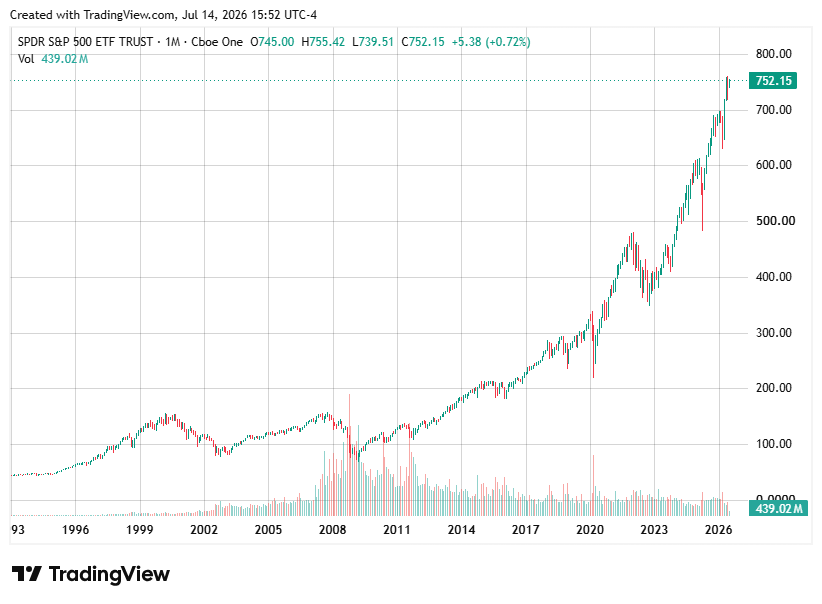
Holding Periods:
1 year - 73% chance of being positive
5 years - 87% chance of being positive
10 years - 94% chance of being positive
15 years - 99%+ chance of being positive
20 years - 100% chance of being positive
If you’re under 67 reading this, you have a very high probability of having your wealth be worth the same or more by the age of 73.
You have an extremely high probability of having your wealth being worth the same or more the next thirty years. THIS IS FACTORING MARKET DOWNTURNS AND CORRECTIONS!!!!
Turn off the news, they are lying to you. “Things have never been worse.”
95%+ of you receiving these emails are over 60. You know good and well it’s been worse before.
Plan like the you have a loaded hand of cards in your favor. The game is yours to lose.
Cheers!
Disclosures:
This blog contains general information that may not be suitable for everyone. The information contained herein should not be construed as personalized investment advice. There is no guarantee that the views and opinions expressed in this blog will come to pass. Investing in the stock market involves gains and losses and may not be suitable for all investors. Information presented herein is subject to change without notice and should not be considered as a solicitation to buy or sell any security. Revolutionary Wealth LLC does not offer legal or tax advice. Please consult the appropriate professional regarding your individual circumstance. Past performance is no guarantee of future results.
Not associated with or endorsed by the Social Security Administration, Medicare or any other government agency.
Maximizing your Social Security Benefits assumes foreknowledge of your date of death. If as an example you wait to claim a higher monthly benefit amount but predecease your average life expectancy, it would have been better to claim your benefits at an earlier age with reduced benefits.
Converting an employer plan account or Traditional IRA to a Roth IRA is a taxable event. Increased taxable income from the Roth IRA conversion may have several consequences including but not limited to, a need for additional tax withholding or estimated tax payments, the loss of certain tax deductions and credits, and higher taxes on Social Security benefits and higher Medicare premiums. Be sure to consult with a qualified tax advisor before making any decisions regarding your IRA.
Mutual Funds and Exchange Traded Funds (ETF’s) are sold by prospectus. Please consider the investment objectives, risks, charges, and expenses carefully before investing. The prospectus, which contains this and other information about the investment company, can be obtained from the Fund Company or your financial professional. Be sure to read the prospectus carefully before deciding whether to invest. An investment in the Fund involves risk, including possible loss of principal.
Indexed annuities are insurance contracts that, depending on the contract, may offer a guaranteed annual interest rate and some participation growth, if any, of a stock market index. Such contracts have substantial variation in terms, costs of guarantees and features and may cap participation or returns in significant ways. Any guarantees offered are backed by the financial strength of the insurance company. Surrender charges apply if not held to the end of the term. Withdrawals are taxed as ordinary income and, if taken prior to 59 ½, a 10% federal tax penalty. Investors are cautioned to carefully review an indexed annuity for its features, costs, risks, and how the variables are calculated. c) If this includes fixed and indexed annuities, you can add this combined version: Fixed Annuities are long term insurance contracts and there is a surrender charge imposed generally during the first 5 to 7 years that you own the annuity contract. Indexed annuities are insurance contracts that, depending on the contract, may offer a guaranteed annual interest rate and some participation growth, if any, of a stock market index. Such contracts have substantial variation in terms, costs of guarantees and features and may cap participation or returns in significant ways. Investors are cautioned to carefully review an indexed annuity for its features, costs, risks, and how the variables are calculated. Any guarantees offered are backed by the financial strength of the insurance company. Surrender charges apply if not held to the end of the term. Withdrawals are taxed as ordinary income and, if taken prior to 59 ½, a 10% federal tax penalty.
The projections or other information generated by Monte Carlo analysis tools regarding the likelihood of various investment outcomes are hypothetical in nature, are based on assumptions that you provide which could prove to be inaccurate over time, do not reflect actual investment results, and are not guarantees of future results, but they can be complemented with additional calculators and tax planning tools. Results may vary with each use and over time.
Securities and investment advisory services offered through Integrity Alliance, LLC, Member SIPC. Integrity Wealth is a marketing name for Integrity Alliance, LLC. Revolutionary Wealth LLC, is not affiliated with Integrity Wealth.
Tax and Legal services provided are separate from the Securities or Advisory services offered through Revolutionary Wealth LLC.