

I was 9 years old standing in Target, holding a pack of 2007 Topps Series 1 Baseball cards. Three bucks.
My mom probably thought she was buying me a distraction. She was actually buying me my first alternative investment.
I didn’t know that then. I just wanted a pack of cards. I did not have a thesis.
I had a three dollar bill and a desire to see what I would pull next.
Most Bets Lose. That’s the Point.
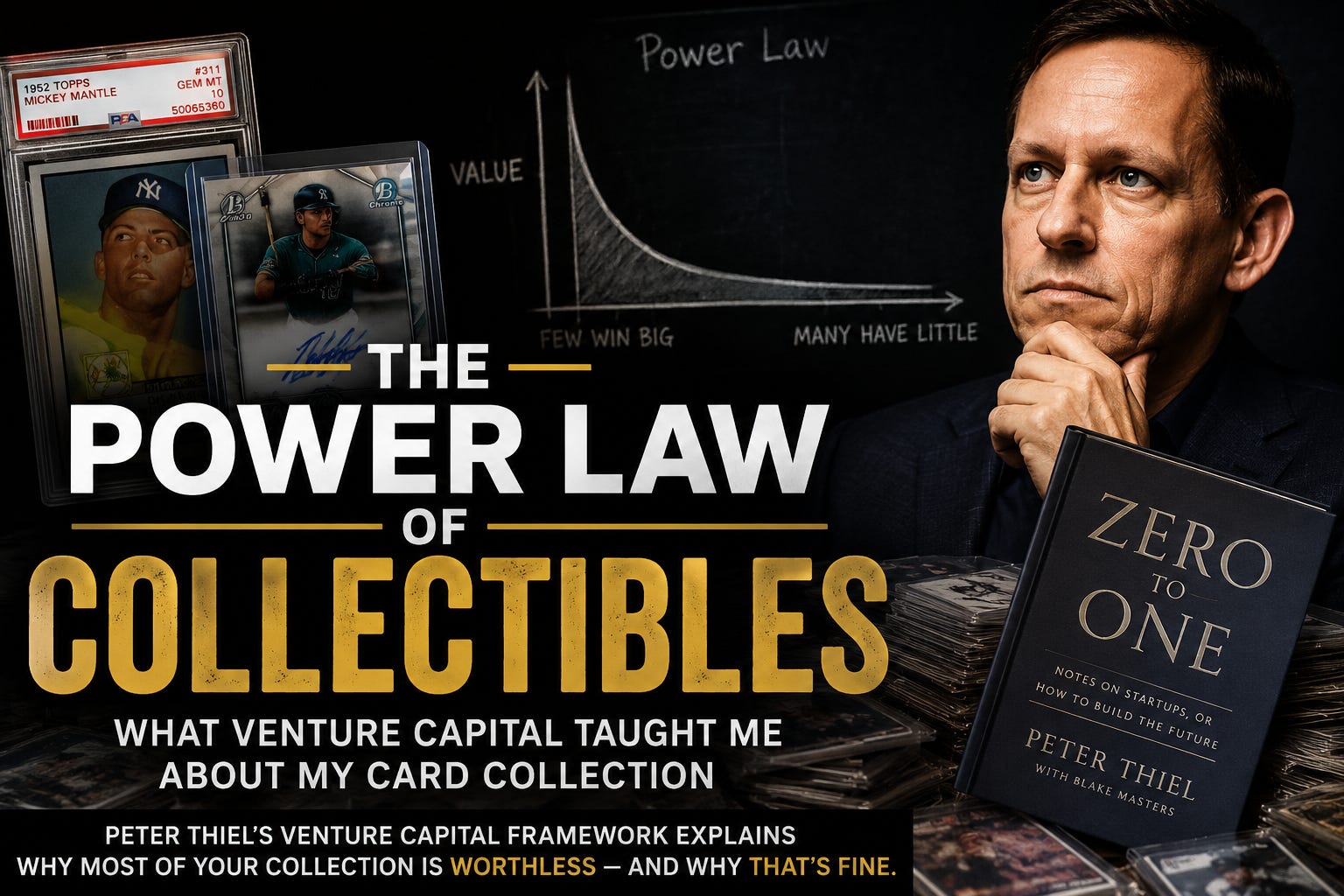
Peter Thiel wrote in Zero to One that venture capital returns follow the power law.
Most investments in a VC fund fail. A few break even. One or two pay for every loss in the portfolio and then some.
Collectibles work the same way.
If you bought a full set of 1990 Marvel Impel cards back then, most of those cards are worth a couple bucks today. Maybe less.
The common hero, the random villain cards, the checklist inserts. They sit in a box. They don’t move.
But a PSA 10 Spider-Man from that same set? Around $1,425. From a $5 pack.
That, ladies and gentlemen, is the power law. One card carrying the weight of the entire box.
The Math Behind Every Winning Card
A venture capitalist might invest in 30 startups knowing 20 will fail outright, 8 will return modest money, and maybe 2 will return 50x or 100x. Those two winners make the fund.
Sports cards, comics, and collectibles follow the same distribution.
Most rookie cards from any draft class are worth less than the pack they came in within five years.
But the one kid who becomes a generational talent turns a $2 card into a $2,000 card. Or a $20,000 card. Or more.
Most comics from the 1990s speculation boom are worthless. Millions of copies, everyone treating them like investments, polybagged with holographic covers. But a clean copy of Amazing Spider-Man #300 (first Venom) from that same era? A CGC 9.8 has sold for over $7,000.
And the real grail, Amazing Fantasy #15 (first Spider-Man appearance, 1962), sold for $3.6 million at Heritage Auctions.
The losers in your collection don’t matter if you hold the right winners long enough.
Concentration Beats Diversification
Thiel’s point wasn’t just “some bets win big.” It was that the power law is so extreme, the single best investment in a fund outperforms all the others combined.
Not by a little. By orders of magnitude.
That means the strategy can’t be diversification for its own sake. In VC, you don’t spread $10 million across 100 companies equally and hope.
You make concentrated bets on things you believe have exponential upside, then you hold.
Same with collectibles. The guy who bought every base card from every set in 1993 and stored them in a closet has a closet full of cardboard.
The guy who spotted a raw Michael Jordan 1993 Topps Finest Refractor at a card shop and paid to get it graded? He’s sitting on an asset.
The skill isn’t buying more. It’s recognizing which pieces have the characteristics of exponential winners:
Low population counts — PSA 10s where only a handful exist
First appearances of characters or players who become culturally permanent
Key rookie cards from athletes with generational talent
Condition rarity — high grade copies of books that were read, not stored
That’s the same evaluation a VC does. Small supply, massive potential demand, something structurally different about this one.
The Estate Planning Blindspot
This is where collectibles investing and financial planning collide, and it’s the part nobody talks about.
You spend 30 years building a collection. You know what’s valuable. You know the PSA 10 Jordan card is worth $5,000 and the raw base cards are worth $0.50.
You know which long boxes have the keys and which ones are filler. You remember your cost basis because you remember what you paid.
Your family doesn’t know any of that.
When you die, your spouse or your kids inherit a collection they can’t evaluate. Without documentation, they’re walking into a few real problems:
They can’t tell the winners from the losers. That’s the power law problem again. 95% of the collection might be worth almost nothing. The 5% that carries real value is mixed in with everything else. Without a clear inventory, the exponential winners get sold in a garage sale box for $20. I’ve seen it happen.
Cost basis disappears. Buy a comic for $50 in 1985 and it’s worth $15,000 today, your heirs get a stepped-up basis at date-of-death value. But only if that value is documented. Without records, the IRS can challenge the valuation. Without receipts, your family can’t prove what was paid. That’s a tax dispute that costs more than the item was ever worth.
Estate valuation gets messy. The IRS expects fair market value for estate tax purposes. A collection with no appraisal and no inventory is a target. Overvalue it, the estate pays too much tax. Undervalue it, you’re inviting an audit.
Forced liquidation kills returns. If the estate needs liquidity and nobody knows what they’re holding, the whole collection gets dumped to a dealer at 30 to 50 cents on the dollar. The power law winners get liquidated right alongside the worthless base cards because nobody took the time to separate them.
A collection with no documentation is wealth your family will never find.
Three Things Your Family Needs in Writing
If your collection is worth more than a few thousand dollars, here’s the plan.
An inventory with values. List the key pieces. Note the grade, the population count, the approximate market value, and where you’d sell it — Heritage, eBay, Goldin, a local dealer. Update it once a year. Your family doesn’t need to understand pop counts. They need to know which items to protect and which ones aren’t worth the effort.
A designated advisor or dealer. Name someone your family can call who understands the market. A trusted dealer, a consignment house, a fellow collector who knows values. Put their contact info in the document. Your spouse shouldn’t have to learn the difference between CGC and CBCS grading on the worst day of their life.
Integration with your estate plan. Your attorney should know the collection exists. If it’s significant, get a formal appraisal for estate tax purposes. Decide now whether specific pieces go to specific people. If your kid loves Marvel, maybe the Spider-Man keys go to them and the sports cards get sold. Make those calls now so nobody has to guess later.
The Power Law Works Both Ways
In VC, the upside of getting it right is generational wealth from one company. The downside of getting it wrong is a total loss, but the fund survives because the winners cover it.
Collectibles work the same way on the upside. The $5 pack that produces a $100,000 Jordan card. The Amazing Fantasy #15 that goes from cover price to $3.6 million. The rookie card pulled from a blaster box that funds your kid’s first car.
But the downside carries an extra layer VC doesn’t have. If you die without a plan, your family can’t tell the rare parallel from the base checklist card.
The power law winners are invisible to someone who doesn’t know what they’re looking at.
How you treat your collection today is how your family will be forced to treat it tomorrow.
The collection you spent decades building deserves thirty minutes of documentation.
Open a spreadsheet tonight. List your five best pieces. Note the grade, the value, and who should get first call. That’s the whole assignment for today.
See you next time, cheers!
Disclosures:
This blog contains general information that may not be suitable for everyone. The information contained herein should not be construed as personalized investment advice. There is no guarantee that the views and opinions expressed in this blog will come to pass. Investing in the stock market involves gains and losses and may not be suitable for all investors. Information presented herein is subject to change without notice and should not be considered as a solicitation to buy or sell any security. Revolutionary Wealth LLC does not offer legal or tax advice. Please consult the appropriate professional regarding your individual circumstance. Past performance is no guarantee of future results.