
It was the second week of November.
My business and our affiliate were both underwater. We were 25% behind our production goal for the year.
Our affiliate was sitting at 30% short of theirs. Two months left on the calendar and the math was not friendly.
The easy response — the one most business owners make — is to keep pushing and hope the final stretch picks up. Work harder. Trust momentum. Put in more hours.
We did not do that.
We sat down and had a candid conversation about what had to happen. Not vaguely. Not “we need to close more business” or “let’s pick up the pace.”
Specifically. Which clients. Which conversations. Which decisions had to be made on which specific dates within a specific window for us to still hit the number.
We laid out the exact sequence that had to execute.
Then we ran it.
We hit our production goal with 3 business days remaining.
That is not a hustle story. That is a situational awareness story.
And the difference between those two things is the difference between success and failure in business and financial planning.
What Situational Awareness Is
Anybody with a sports background already understands this concept intuitively.
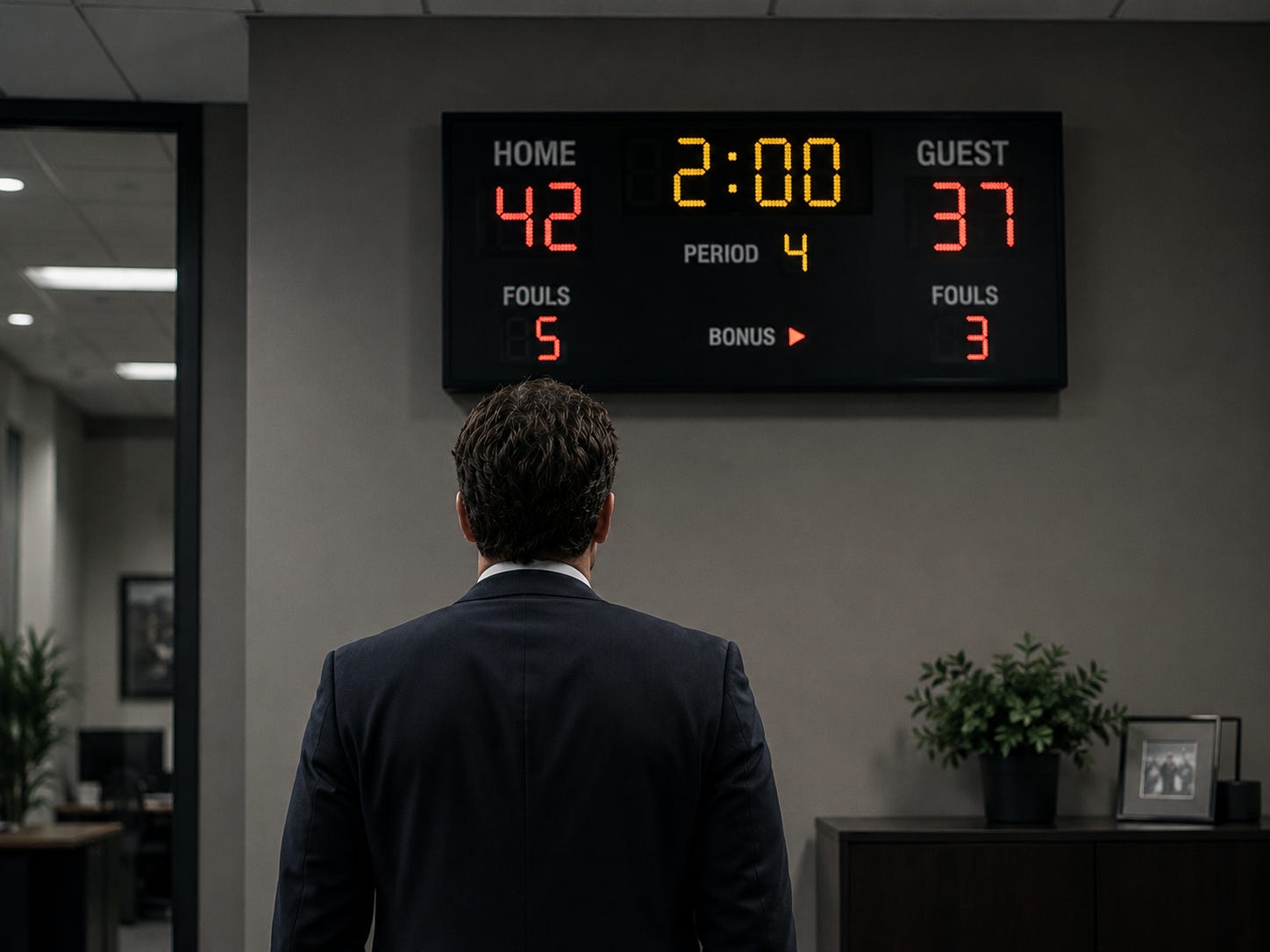
You are playing football. It is the two-minute warning. You are down by three. You know exactly which plays you are running. You know where to line up.
You know that if a certain route doesn’t open, you go to your checkdown immediately — because time is the resource you cannot recover.
Baseball. You are on the base paths in the seventh inning with two outs. The count goes full. Before the pitch even happens, you already know what you are doing.
Every scenario is pre-processed. Speed, angle, the outfielder’s arm — you have read the situation and prepared your response before the situation demands it.
That is situational awareness. The real-time processing of where you are in the game, what the moment demands, and what has to happen next.
Elite athletes do it without thinking. The great ones make it look effortless because they have rehearsed every scenario until the right response is automatic.
The same thing is true in business. The same thing is true in your financial plan.
The question is whether you are actually doing it.
The Biggest Mistake Business Owners Make
I watch business owners work hard every day. I do not question the effort. What I question is the awareness.
There is a version of running a business that looks like this: January, full of energy and good intentions. February and March, grinding. By July, you have a general sense of whether it has been a good year or a slow one. December hits and you find out the score.
That is not a business strategy. That is hope with a calendar attached.
The biggest mistake I see — from owners I respect, people working genuinely hard — is confusing effort with situational awareness.
You can work 60 hours a week and still not know where you are relative to your goal.
You can care deeply about your business and still not have a clear read on the specific levers that determine whether December 31st is a win or a miss.
Somebody in every organization has to stop and call the moment.
Has to say out loud: this is where we are, this is where we need to be, here is the specific gap, and here is the sequence that closes it.
In most small businesses, that person is the owner. It does not have to stay there. But somebody has to play that role. When nobody does, the two-minute drill never gets called.
Subscribe now to keep reading. Each week I break down the real moves that separate the owners and retirees who win from the ones who wonder what happened.
The Sequence That Saved November
When my business partner and I sat down the second week of November, we did not talk about effort. We did not motivate each other. We talked about math.
25% short. 30% short. Eight weeks. Here is what has to happen.
We identified which specific conversations needed to happen, with which clients, by which dates. We built a sequence. Not a general plan — a sequence.
This conversation by this date. This decision by this date. This close by this date. If these slip, here is the contingency.
Then we executed it.
Three business days left in December; we crossed the line.
The reason we hit the goal was not that we worked harder in December than we had in October.
The reason we hit the goal is that we knew exactly what had to happen and we called it with enough runway for the sequence to execute.
Situational awareness gave us a window. We used it.
Situational Awareness for Clients
Last year, a client came to me sitting on the fence about an annuity.
Rates were being cut. There was a real sense that the market could correct. The environment was moving. And she was not sure. She wanted more time. She wanted to wait and see.
We had a now-or-never conversation.
Not pressure — I want to be clear about that. It was an honest, direct read of her situation.
Where rates were going. What the market was signaling. What waiting another 30 or 60 days actually cost her in real numbers. What she was trying to protect and what the window for protecting it actually looked like.
She made the decision that day.
Eighteen months later, she is up 35% with 55% principal protection. The market has done what markets do — it has moved, shaken, created the kind of uncertainty that keeps people up at night.
She slept fine. Because she made her decision when the situation called for one, not when she finally felt completely comfortable.
Comfort is not a strategy. Comfort is a feeling. The situation demanded a response. She responded.
That is situational awareness applied to financial planning.
Three Questions Every Owner and Planner Need to Answer
Situational awareness, applied practically, comes down to three questions. Most people cannot answer all three on a given Tuesday in October. Ask yourself right now.
Where are you relative to your goal, specifically?
Not a general sense. Not “we’re doing okay” or “a little behind.”
What is the number? If your production goal is $1.4 million and it is November 7th, what do you need to close in the next eight weeks to still hit it?
Put the number on the table and look at it.
What has to happen, on which specific dates, to close the gap?
Not “we need to pick it up.” Which conversations. Which clients. Which decisions.
The sequence has to be specific enough that you can put it on a calendar. If you cannot schedule it, it is not a plan. It is wishful thinking.
Who is responsible for calling the moment?
This is the question most businesses never ask. Somebody has to hold situational awareness as their job. Somebody has to be the one who stops and reads the game.
In a small business, that is usually the owner. In a financial plan, it is your advisor — or it has to be you.
When nobody owns this role, the two-minute warning comes and goes without anyone noticing.
The Difference Between Success and Failure
My business partner and I did not discover some secret to production in November.
We sat down, called the situation as it was, built a specific sequence, and executed it.
Three business days left. Goal hit.
My client did not stumble into a 35% gain with principal protection. She made a decision when the window was open. The window is gone now.
The people who hit their goals are not smarter than the people who miss them. They are not working harder.
They are more aware of the game they are in, and they have someone — themselves or a trusted advisor — calling the moment when the moment arrives.
The two-minute drill requires someone running it.
Are you situationally aware?
That is the difference.
Disclosures:
This blog contains general information that may not be suitable for everyone. The information contained herein should not be construed as personalized investment advice. There is no guarantee that the views and opinions expressed in this blog will come to pass. Investing in the stock market involves gains and losses and may not be suitable for all investors. Information presented herein is subject to change without notice and should not be considered as a solicitation to buy or sell any security. Revolutionary Wealth LLC does not offer legal or tax advice. Please consult the appropriate professional regarding your individual circumstance. Past performance is no guarantee of future results.
Not associated with or endorsed by the Social Security Administration, Medicare or any other government agency.
Maximizing your Social Security Benefits assumes foreknowledge of your date of death. If as an example you wait to claim a higher monthly benefit amount but predecease your average life expectancy, it would have been better to claim your benefits at an earlier age with reduced benefits.
Converting an employer plan account or Traditional IRA to a Roth IRA is a taxable event. Increased taxable income from the Roth IRA conversion may have several consequences including but not limited to, a need for additional tax withholding or estimated tax payments, the loss of certain tax deductions and credits, and higher taxes on Social Security benefits and higher Medicare premiums. Be sure to consult with a qualified tax advisor before making any decisions regarding your IRA.