

Every collector remembers the feeling before the last pack. Heart rate up a little.
Already spending the money in your head. That feeling has a name, and it’s not “market analysis.”
It’s the same feeling a slot machine is engineered to produce, and once you see that, you can’t unsee it.
So I ran the numbers. Not the vibes. The actual math behind breaking a box versus playing a casino game versus buying a specific card because the data told you to.
The answer surprised me, and it’s probably going to bother some people in the comments.
The Odds Are Printed. You Just Never Read Them.
Every hobby box has odds printed right on the box, the same way a slot machine has a payout table nobody reads before they sit down.
A standard hobby box might carry something like 1:46 odds on a rookie autograph. Buy the premium tier of the same product, and the odds might jump to 1:2. Chase the single best autograph in a different release, and you’re looking at something closer to 1 in 96,027.
Now compare that to Vegas. A slot machine’s house edge typically runs 2% to 10%, with most machines sitting in the 4% to 5% range. That means for every dollar you feed the machine, you get back somewhere between 90 and 98 cents on average.
Blackjack, played with correct basic strategy, gets the house edge down under 1%, sometimes as low as 0.28%. Roulette sits around 5.26%.
Here’s the part that stings. Hobby consensus has long held that if you break even at half your box cost back in cards, you had a good day. Read that again.
A slot machine gives you 95 cents back on the dollar. A well-known hobby rule of thumb says a box giving you 50 cents back on the dollar is a win. That’s not better odds than Vegas.
That’s a casino floor with no regulator, no audited payout table, and a house edge that can run ten times worse than the slots.
The Gambler’s Fallacy Lives in Every Card Shop
If you’ve ever broken four boxes with nothing and told yourself the fifth one is “due,” you already know what the gambler’s fallacy feels like from the inside.
The math does not care what happened in your last box. Each box is an independent event, exactly like each spin of a roulette wheel.
The autograph odds printed on box five are identical to the odds printed on box one, no matter how empty boxes two through four came up. A roulette player who bets on red after five blacks in a row is making the same mental error as a collector who buys a sixth box because they feel “overdue.”
The wheel has no memory. Neither does the case of boxes at your local shop.
That, ladies and gentlemen, is the difference between a feeling and a fact. Feelings tell you a hit is coming.
Math tells you the odds reset to zero every single time you pull the trigger on a new box.
What Investing In Cards Actually Looks Like
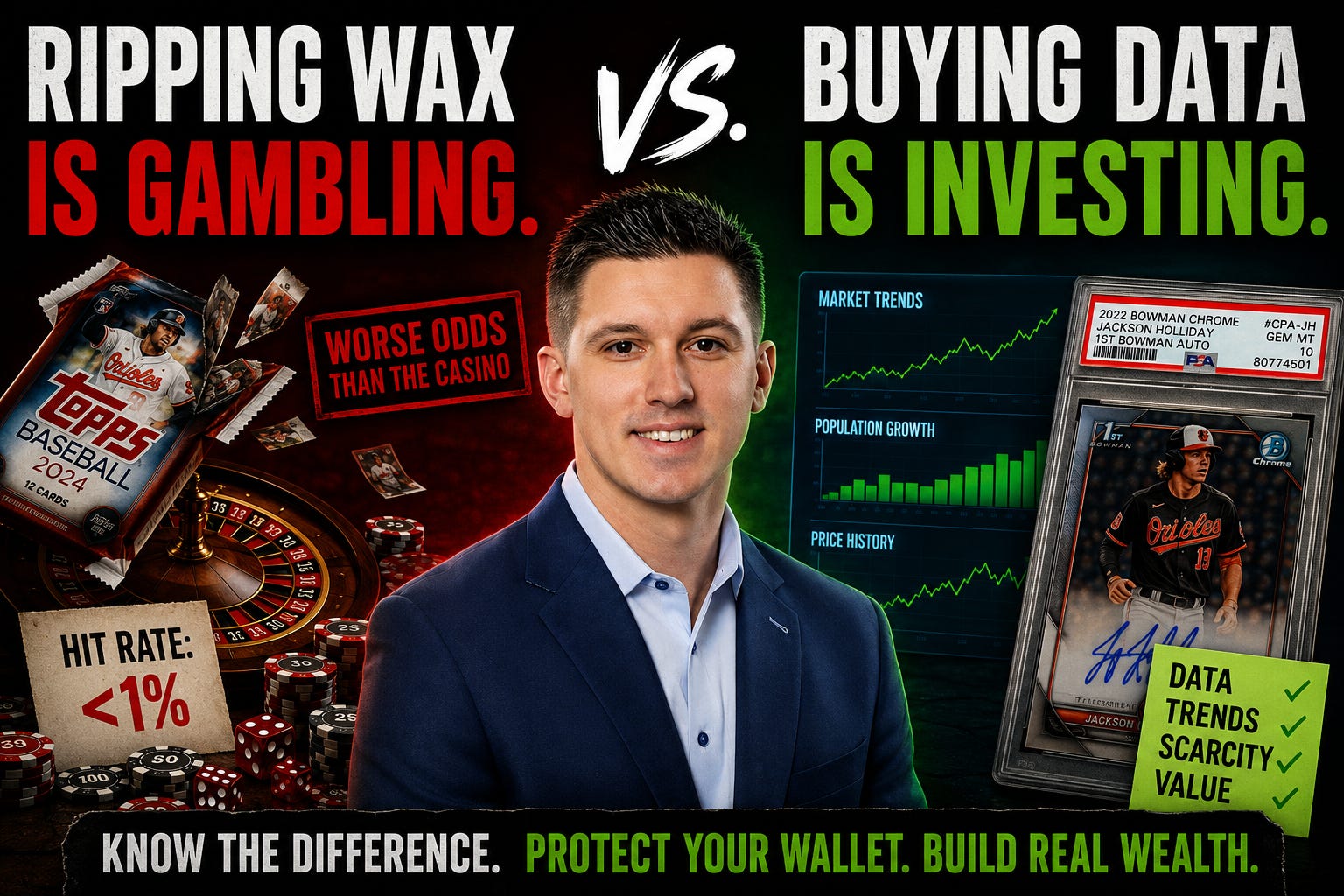
Here’s where it flips. Buying a specific card because of what the data says is a completely different activity than opening a box and hoping.
When you buy a graded single off the secondary market, you can check the PSA or SGC population report and know exactly how many exist in that grade.
You can look at the player’s actual on-field performance trend instead of guessing. You can pull ninety days of sold comps and see the real price, not the price someone is hoping for in an active listing.
None of that information exists inside a sealed box.
That’s the whole distinction. Box breaking is a fixed game where the printed odds cannot be moved by research, effort, or skill.
Buying a specific asset based on population data, performance trends, and real market comps is a game where information gives you an actual edge.
The Three-Question Test Before You Buy
Before your next purchase, run it through this filter.
The Repeatable Test. If you made this exact decision 100 times, would you expect to come out ahead on average, or does it only work if you get lucky once? Box breaking fails this test by design. A specific card bought below its data-backed value passes it.
The Population Report Test. Do you actually know how many copies exist in that grade, or are you just buying because the auction looks exciting? If you can’t answer that question with a number, you’re gambling, not investing.
The Walk-Away Test. If you never open another pack again, does your strategy still make money? An investor and operator’s answer is yes.
A box breaker’s answer is no, because the profit only exists the moment a wrapper comes off if it falls their way.
Your Next Move
You don’t need to swear off box breaks forever. Plenty of collectors do it purely for the entertainment, the same way plenty of people enjoy a weekend in Vegas without confusing it for a retirement plan.
The mistake is calling it investing when it’s actually entertainment with a printed house edge worse than the casino down the street.
Before you buy your next box, spend ten minutes pulling the population report on the chase card you’re actually hoping to hit. Check what a raw or graded copy of that exact card is already selling for on the secondary market.
Compare that number to what the box costs. That ten minutes of math will tell you, before you rip a single wrapper, whether you’re about to invest or about to gamble.
How you do anything is how you do everything, and that includes whether you let a printed house edge decide your hobby budget or whether you decide it yourself.
See you next time, cheers!
Disclosures:
This blog contains general information that may not be suitable for everyone. The information contained herein should not be construed as personalized investment advice. There is no guarantee that the views and opinions expressed in this blog will come to pass. Investing in the stock market involves gains and losses and may not be suitable for all investors. Information presented herein is subject to change without notice and should not be considered as a solicitation to buy or sell any security. Revolutionary Wealth LLC does not offer legal or tax advice. Please consult the appropriate professional regarding your individual circumstance. Past performance is no guarantee of future results.
Asset protection plans should be developed and implemented well before problems arise. Due to the fraudulent transfer laws, asset transfers that occur close in proximity to the filing of a lawsuit or bankruptcy can be interpreted by the court as a fraudulent transfer. Proper structuring of these assets is imperative please seek proper legal and tax advice prior to engaging in re-titling/structuring of any assets. Please note that laws are subject to change and can have an impact on your asset protection strategy.